
On more than one occasion we've spoken about redundant internet. Why you may not want to put all your eggs in one basket. Here and here to be precise.
Often this all boils down to one very practical question: "If my internet goes down right now, how much money am I losing?" Whether you’re running a business like AFSecure, a busy retail shop in Melbourne, or a regional accounting firm, the internet may be "just a utility" you pay every month. But much like the power, it's a utility that has the ability to stop your business operations.
In the last post, I touched on the concept of network diversity. Today, I’m taking you behind the scenes of my own setup. In the interest of "eating our own dog food," I’m sharing exactly how I use a combination of NBN, 5G, and Starlink to ensure that no matter what happens to the infrastructure in my street, my business' lights stay on.
First some context - I have three primary places I often work:
- From a virtual office I rent in Melbourne, this has its own redundant internet and for this I use a travel router to provide secure connectivity. It's also primarily used as a space for meeting rooms or a hot-desk when meeting city-based clients.
- From my home office - this is where I spend the majority of my time working and the most critical for business operations.
- From a client's site.
The redundancy I'm talking about is related to my home office.
The Primary Workhorse: NBN FTTP
If you have access to it, NBN's Fibre to the Premises (FTTP) connection is the gold standard. It’s my primary connection for a simple reason: it is incredibly cost-effective for the performance it provides. For my business, we use a 1000/100 Mbps plan, which gives us the "heavy lifting" capacity needed for large data transfers, video conferencing, and daily security consulting tasks.
However, as reliable as fibre is, it’s not invincible. All it takes is a stray backhoe during roadworks or a major hardware failure at the local exchange to turn a productive Tuesday into a total standstill. This is where redundancy moves from a "nice-to-have" to a business necessity.
The First Safety Net: 5G Mobile Backup
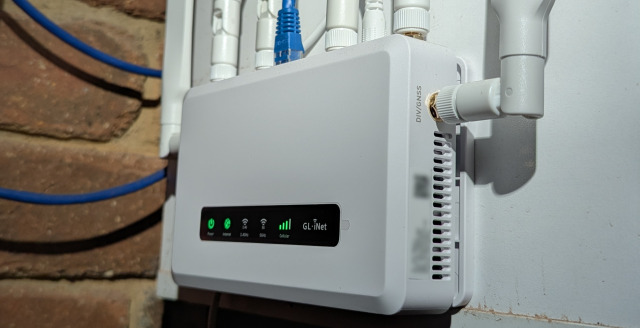 5G backup router, tucked in a dusty corner of my garage.
If the NBN goes quiet, the "next cab off the rank" in my setup is a 5G mobile connection. I use an annual prepaid data plan for this, which serves two distinct purposes:
- Urban Portability: When I’m working remotely in the city or a client’s office without guest Wi-Fi, the 5G modem is a "no-fuss" solution that keeps me securely connected.
- Short-Term Failover: For those "blip" outages where the NBN is down for an hour or two, 5G is perfect. It’s fast, low-latency, and kicks in automatically.
The catch? Data costs. While 5G is great for a quick fix, using it for a multi-day outage- especially with heavy cloud backups or video calls - can quickly become expensive. If someone puts a shovel through a fibre line and the repair time is "unknown," I need a more sustainable plan.
The Ultimate Insurance: Starlink in "Standby"
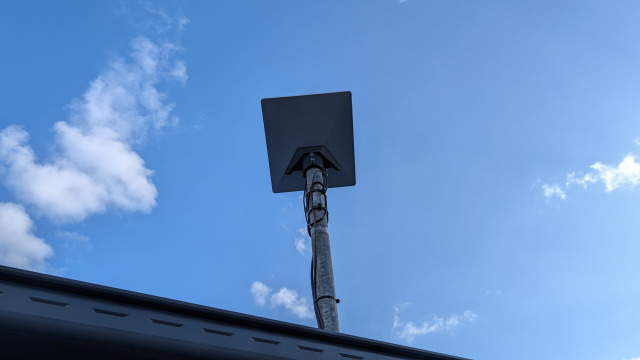 Starlink installed on the roof.
This is where Starlink comes into play. For many, Starlink is seen as a solution only for the Outback, but I’ve found it to be the ultimate redundancy tool for a Melbourne-based business.
For times I need to take it on the road, I have my Starlink Mini unit mounted in a spot where I can reach it quickly with a ladder. When it's not enabling me to work remotely in a rural setting, it sits mounted to my roof in Standby Mode. At the time of writing, this costs roughly $8.50 AUD per month. This "always-on" connection is limited to 0.5 Mbps - barely enough to check an email - but its real value is in its flexibility.
If my NBN is looking at a long-term outage (think days, not hours), I don't lean on my expensive 5G data. Instead, I simply jump into the Starlink app and "un-pause" the service to a full-speed plan. Within minutes, I have high-speed, unlimited satellite internet.
_Think of your internet like your office power.
- The NBN is your mains power.
- 5G is like a small battery UPS that keeps your PC alive for a few minutes.
- Starlink is the diesel generator out the back that can run the whole building until the grid is repaired._
Why "Overkill" is Actually Good Business
Having three different internet connections might sound like overkill. However, for my business, downtime is a cost I simply cannot bear. If I can’t reach a client or access a secure network, I’m not just losing time—I’m losing trust. But here's the kicker - they aren't just redundant connections, they're flexible options to keep myself online on the road too.
- If I'm traveling to a regional area and need to keep the business online, I an-mount the Starlink dish from my roof and take it with me.
- If I'm going to be in an urban area for an extended period without guest Wifi at my disposal, I collect my 5G router from it's spot in my garage and pop it in my bag.
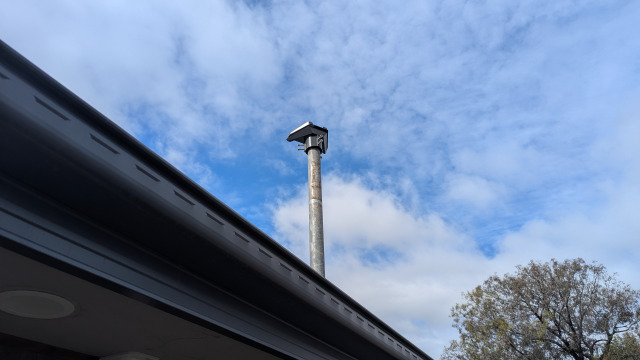 Starlink pole when the unit is removed.
Further, carefully planning my connectivity, I’ve achieved two major goals:
- Infrastructure Diversity: I have a physical wire (NBN), a local tower (5G), and a satellite (Starlink). It is highly unlikely that all three will fail simultaneously.
- Financial Flexibility: I only pay for high-speed satellite data when I actually need it, keeping my monthly overheads low while keeping my "insurance" active.
Whether you are traveling regionally or just want to make sure a local NBN outage doesn't tank your week's productivity, looking beyond a single connection is the smartest move you can make for your business resilience.
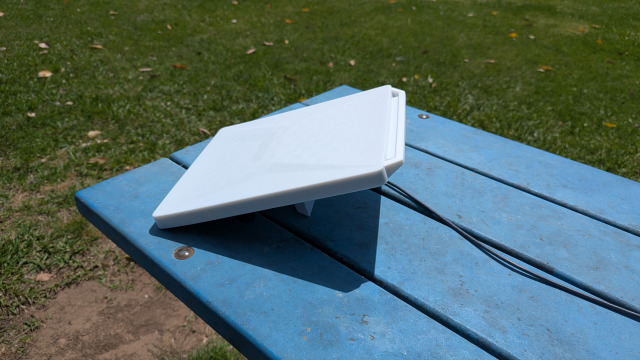 Starlink unit from a day working on the road.
Ready to build a more resilient network?
At AFSecure, we specialise in designing secure, redundant network solutions tailored to the unique needs of Australian small businesses. Whether you're looking to integrate Starlink or simply want to shore up your current Wi-Fi, we're here to help.